When Spanish Glazed Chops is on the card
“Well, honey, pull up a chair,” is how I would begin, because Spanish Glazed Chops is not the sort of dish that likes to be discussed from the doorway. It asks for a proper seat, a clear corner of the table, and enough time to remember where the good potholder wandered off to.
Pull up a chair, honey. A good kitchen story should never be told from the doorway.
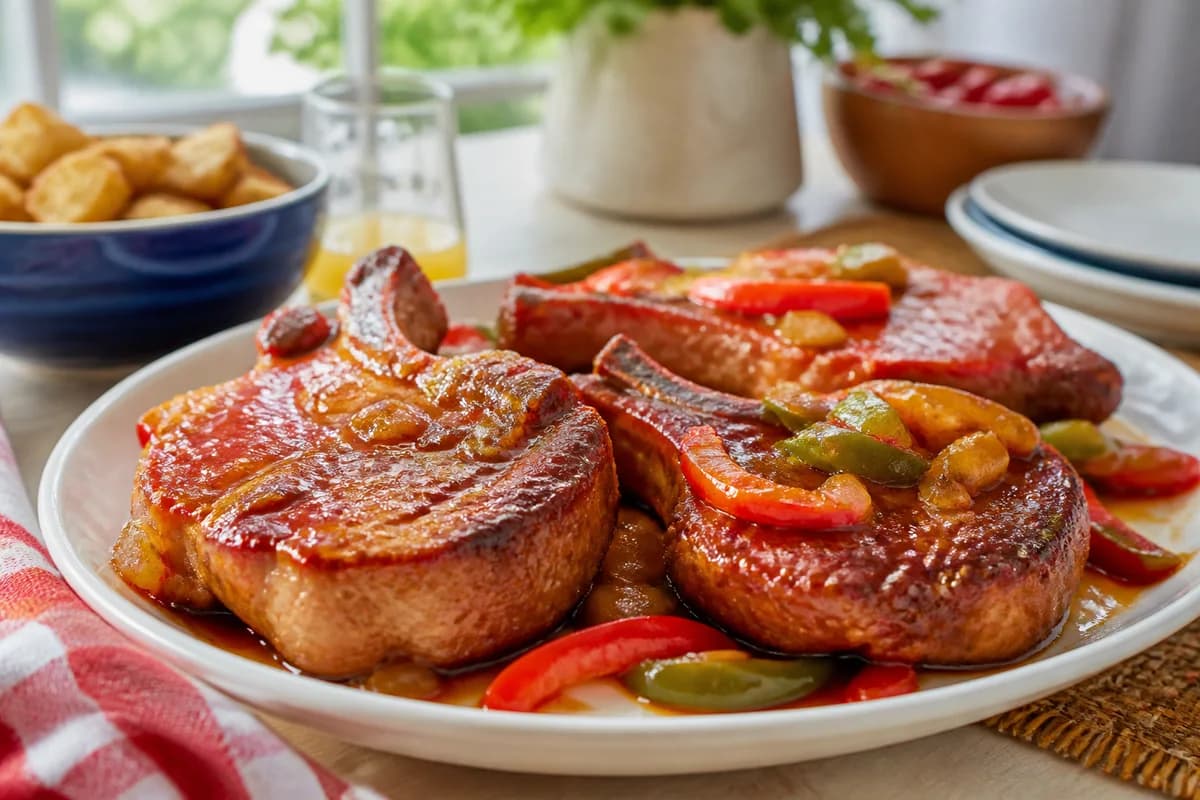
A savory old-fashioned pork chop dish made with pork chops, onion, garlic chili sauce, Worcestershire sauce, vinegar, brown sugar, and beer—browned in a skillet, then simmered until tender in a glossy tangy glaze. Its catalog connection points to Official family collection, a detail worth keeping beside the card. The recipe facts come from the archive; the chatter, the missing potholder, and this grandmotherly voice are affectionate editorial storytelling. I will never pretend the card tells us a family history it does not actually contain.
Still, a card does not have to supply every laugh in the room. I can picture the ordinary little ritual: sleeves pushed up, a dish towel tucked close, and one brave person volunteering to help before discovering that “helping” includes finding the missing lid. That part belongs to imagination, but any busy cook will recognize the feeling.
Make a little room on the counter
The first order of business is gathering 6 (1/2-inch thick) pork chops, 1/4 cup flour, 2 tablespoons oil. “Put everything where you can see it,” I tell the imaginary helper at my elbow, “or the brown sugar will hide behind the flour and act innocent.”
There is comfort in taking a recipe one line at a time. I may fuss about runaway spoons and crowded counters, but I will not improvise the measurements for you. The exact ingredients belong on the archived recipe page, where they can be followed as recorded and checked against the source information.
Now and then, pause long enough to put one thing away. Not everything, mind you; we are not staging a photograph while supper gets cold. Just enough to keep your elbow out of the mixing bowl. “Order is useful,” I say, “but a little flour on your apron proves you showed up for the work.”
Now, don’t pester the stove
The directions for Spanish Glazed Chops deserve the cook’s attention, especially once the room begins to smell promising and patience becomes the scarcest ingredient. That is usually when a curious soul wanders in, peers over your shoulder, and asks whether it is done. “It will not cook faster under supervision,” I remind them, kindly but with meaning.
A timer is useful, dear. So is listening when it tells you something.
Use the archived method for the actual preparation. This story cannot supply what the card does not say, but I can recommend a cleared workspace, a reliable timer, and the courage to ignore anyone who claims their grandmother never measured. Grandmothers measured plenty, dear. Some of us were simply quick enough that nobody noticed.
Why it belongs in Sunday Suppers
Spanish Glazed Chops fits Sunday Suppers because a familiar dish does more than quiet an appetite. It gives people a reason to pause, trade the day’s news, and stay at the table long enough for the quiet person to deliver the funniest remark of the evening.
That scene is not a claim about the original owner of this card. It is an imagined kitchen moment inspired by the recipe and by ordinary home habits: making enough, making room, and pretending not to notice when somebody samples a bite before the serving dish arrives. “Quality control,” they call it. I was not born yesterday.
The nicest tables are rarely the quietest. Forks tap plates, chairs scoot, and one story interrupts another until nobody remembers who started the conversation. A good dish can hold the middle of all that happy commotion without asking for applause. It simply keeps being passed from hand to hand.
Keep the card close
The best next step is to open the Spanish Glazed Chops recipe and cook from its preserved ingredients and directions. Read the source notes, observe any modern safety guidance, and change a catalog fact only when there is evidence for the correction. A recipe box keeps its heart best when accuracy and pleasure sit side by side.
Recipes are meant to be used, not admired until the ink gets lonely.
Then serve it while it is ready and the conversation is still warming up. “There is always room for one more chair,” I like to say, though somebody may have to fetch the folding one from the hall closet. A recipe box earns its keep when the cards come out, the dishes are made, and the kitchen gathers one more story worth telling—with only a modest amount of discussion about who must wash all those bowls.